Considering a switch to open-source networking?
Explore the reasons to choose an open-source NOS like SONiC, along with a breakdown of the Total Cost of Ownership (TCO) for both proprietary and open-source solutions.
SONiC (Software for Open Networking in the Cloud) has gained significant popularity as an open-source Network Operating System (NOS) in data centers. This trend extends to edge and campus environments, driven by hyperscalers’ successful deployments of SONiC, demonstrating its growing adoption across various use cases. For those willing to invest the necessary effort, open networking can offer a level of flexibility, cost-effectiveness, and innovation that proprietary solutions struggle to match. But is SONiC truly an all-or-nothing proposition? Let’s delve deeper.

Companies should carefully evaluate their readiness before adopting SONiC. The decision has to be based on technical capabilities, resource availability, and long-term networking strategy. Here are 10 reasons not to use SONiC NOS in your network infrastructure:

Overall, while implementing SONiC is a critical decision, it unlocks significant advantages for organizations ready to embrace open networking.


Customization
With proprietary solutions, customization – like adding a new protocol or modifying an existing one – depends on the scale of your network (over 100,000 switches) unless you're a highly valuable customer (like Amazon or Orange) with custom support agreements. However, open-source SONiC empowers you to tailor the software to your specific needs, offering greater flexibility and control.

Freedom from Vendor Lock-In
Vendors of proprietary solutions lock customers into their ecosystem. Today's discount might not exist tomorrow, and hidden costs like support fees can emerge later. With SONiC, organizations are not beholden to any single manufacturer, allowing them to leverage the best hardware at the best price.

Open-Source Talent Pool and Solutions
SONiC taps into a global pool of open-source engineers. This not only reduces reliance on a single vendor's support team but also allows attracting skilled personnel who specialize in open-source networking. Furthermore, there's a SONiC community where you can consult with experts and potentially find solutions tailored to your specific use case.

Collaborative Environment and Time to Value
Building network infrastructure with SONiC leverages the community's collective 7 years of experience and readily available solutions, saving valuable time in deployment for your business. Additionally, innovations from other users, with strong use cases and significant implementations, can be integrated into existing network infrastructure.
It’s crucial to understand that open-source SONiC is not free in terms of required resources. The responsibility for tasks traditionally handled by proprietary vendors partially now falls on you. Are you prepared to invest the resources to manage this more hands-on approach?
This questionnaire is designed to assess an organization’s readiness to implement SONiC in their network infrastructure. It covers 7 key areas that are critical for successful SONiC adoption.
Answer each question honestly, assigning a score:
5 – strongly agree,
4 – agree,
3 – not sure,
2 – disagree,
1 – strongly disagree.
Sum up the scores to get your total. This will help you gauge your overall readiness for SONiC implementation and identify areas that may need improvement before proceeding.
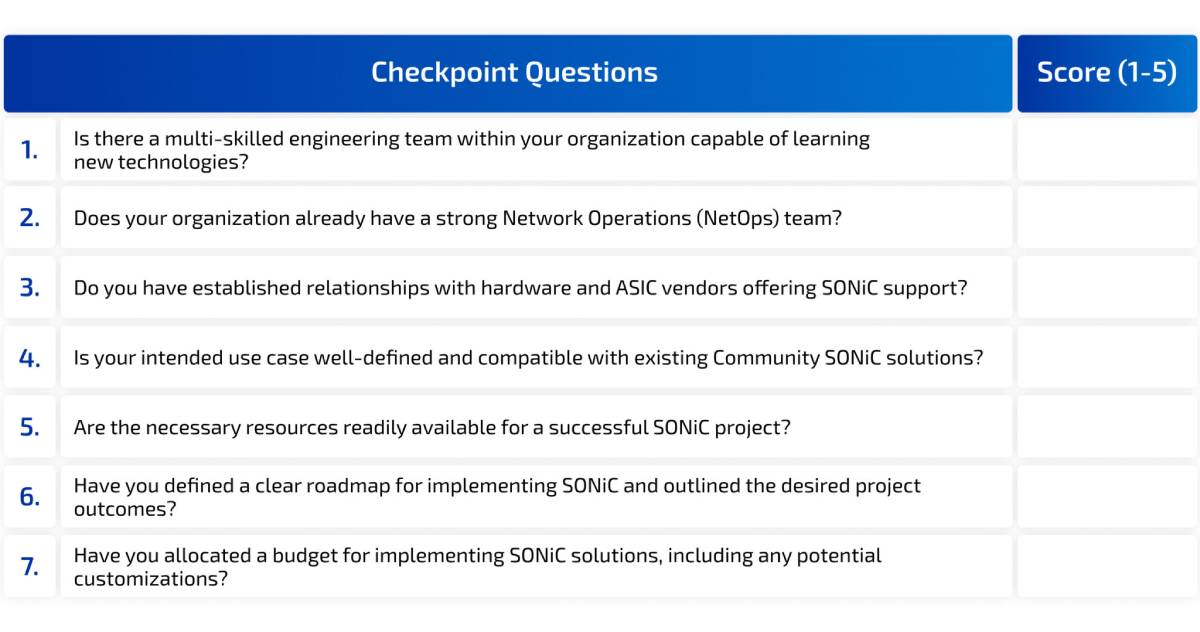
Total Score: _____ / 35
Decision Points:
Note: This questionnaire is a simplified tool. It doesn’t capture every nuance of your organization’s situation. Use it as a starting point for discussions and further analysis, not as the sole decision-making factor. Also, we recommend exploring a breakdown of the Total Cost of Ownership (TCO) for both proprietary and open-source solutions.
Considering a switch to open-source networking?
Explore the reasons to choose an open-source NOS like SONiC, along with a breakdown of the Total Cost of Ownership (TCO) for both proprietary and open-source solutions.

While SONiC offers significant advantages, it requires careful consideration before deployment. If you’re unsure about your SONiC readiness or require expert guidance, PLVision can help. We offer a comprehensive range of services, including:
Leveraging a collaborative approach, PLVision understands specific needs and tailors open networking solutions, empowering clients to prioritize core business activities.
Let's explore how we can empower your organization to embrace the benefits of innovative solutions tailored to your specific use case.

Chief Technology Officer at PLVision
Leonid Khedyk is Chief Technology Officer at PLVision. He has been working in the networking and embedded systems domains for over 15 years. With diverse technical background formed at the intersection of legacy networking approach and SDN, Leonid is leading PLVision’s contribution to open source and its commitment towards driving networking innovation. He is a frequent speaker at industry events and contributor to PLVision’s tech blog. Leonid received his Master’s degree in Computer Engineering from Lviv Polytechnic University.
Related Articles